 8 octobre 2026 au Salon Industrie Grand Ouest à Nantes. Prenez rendez-vous dès maintenant
How to Effectively Reuse Your Company’s Document Repository for Tender Responses in the AI Era

Date
July, 2026
Reading time
10 minutes
Catégory
Best practice
Peggy Herman
Co-founder and Managing Director of Bee4win, where she oversees the company’s consulting and pre-sales service activities. Since 2002, she has managed numerous public and private tenders, ranging from a few tens of thousands to several hundred million euros, in sectors as varied as IT, energy, industry and events.
An expert in pre-sales, Peggy continues to provide bid management and writing services, coaching and training. She has also been conducting studies on best practices in this field for over 10 years. Committed to the development of the pre-sales profession, she is president of the French-speaking chapter of APMP and a frequent speaker at events including the Bid and Proposal Conference Europe and Bee4win’s customers.
Key words
#Goodpractice
#Tenders
#DocumentRepository
When responding to a Request for Proposals (RFP) or tender, presales teams rarely start from a blank page. They rely on a document repository built over the years: past tender responses, technical proposals, marketing arguments, product documentation, sales presentations, case studies, project feedback, and methodology documents.
This accumulated knowledge represents a genuine strategic asset for the company. When properly leveraged, it enables bid managers to save time, improve response consistency, and showcase the expertise built by their teams.
The emergence of generative artificial intelligence solutions opens up new opportunities. They now make it possible to search for information faster, identify relevant content within a large volume of documents, and assist in producing an initial response draft.
AI can significantly boost presales team efficiency—provided it is used with the right methodology. Poorly managed, it can instead degrade response quality, cause irrelevant content to proliferate across your repository, and even lead to non-compliant bids that risk rejection.
In this article, we will examine why knowledge capitalization has become essential for presales teams, the pitfalls to avoid, and the approach to adopt to effectively leverage your company’s document repository to produce winning tender responses.
1. Why Capitalize Your Company’s Document Repository for Tender Responses?
Every tender mobilizes expertise that already exists within the organization. However, this knowledge often remains scattered across different tools and files:
- Past commercial proposals,
- Technical response dossiers,
- Marketing collateral,
- Product documentation,
- Subject matter expert answers,
- Project feedback and lessons learned.
This dispersion leads to significant inefficiency: teams spend valuable time searching for information that already exists simply because they cannot find it quickly.
An effective knowledge capitalization approach helps to:
- Reduce the time spent drafting technical proposals,
- Avoid starting from scratch for every opportunity,
- Reuse top-performing arguments and examples,
- Harmonize responses across different teams,
- Preserve and share internal knowledge.
However, the goal is not to build a library containing every single document ever produced by the company. It is to possess the capability to quickly retrieve the most relevant content to address a specific set of requirements.
2. Pitfalls to Avoid When Reusing Your Document Repository
Pitfall #1: Trying to Draft the Entire Technical Proposal from Existing Content
Not all content in a tender response carries the same reusability value.
Certain sections can be capitalized effectively because they remain relatively stable over time. Examples include:
- Company presentation,
- Project methodologies,
- Organization and governance structure,
- Standard offer presentations or product descriptions,
- Quality processes,
- Security and data protection (GDPR) commitments,
- CSR (Corporate Social Responsibility) commitments,
- Client references and case studies,
- Responses to frequently asked requirements.
Conversely, other elements must be crafted specifically for each consultation:
- Understanding of the client’s needs,
- Analysis of key challenges,
- Value proposition,
- Expected business benefits,
- Custom solution design, etc.
These elements demonstrate that the company truly understands the client’s unique context and are often decisive during the evaluation phase.
Best Practice: Use your document repository as a source of inspiration and reusable content, but dedicate specific effort to the sections that truly make a difference.
Pitfall #2: Attempting to Create an Overly Detailed and Overly Structured Knowledge Base
When a company sets out to build a reusable content repository, a common mistake is trying to break everything down into tiny content blocks and categorize every single piece. This approach can quickly turn into a complex, costly project to maintain, as precisely indexing and continuously updating content requires immense effort.
Generative AI solutions transform this dynamic. They allow users to explore a collection of documents and identify relevant excerpts based on a question, requirement, or expressed need.
As a result, manually building an ultra-structured database is no longer necessary.
However, dumping your company’s entire uncurated documentation into a single AI knowledge base isn’t ideal either. While fast to assemble, such a base will inevitably contain outdated or irrelevant documents. When you rely on your preferred AI tool to find reusable material, there is a high probability it will pull content that is suboptimal or obsolete for your specific bid.
Best Practice: Build a curated reference repository comprising a selection of your best documents (past winning responses, marketing pitch decks, product datasheets, etc.) whose content has been validated or is of high quality. Keep the folder structure simple to facilitate updates. Establish lightweight governance to refresh this repository—for example, every 3 months (adding new strong examples and removing outdated documents).
By prioritizing quality over quantity in your document repository, you will dramatically improve the relevance of the content proposed by the AI during searches.
Pitfall #3: Copy-Pasting Existing Content Without Customizing It
Even when highly relevant content is retrieved, it should never be reused as-is without adaptation.
Every tender comes with its own unique context:
- Specific client expectations,
- Evaluation criteria,
- Technical constraints,
- Level of maturity,
- Terminology and vocabulary used.
An effective response must demonstrate that the company thoroughly understands the specific needs expressed in the RFP documents.
Best Practice: Treat content retrieved from your repository as raw material: it provides proven arguments, examples, and phrasing, but it must be tailored to the context of the new tender.
Pitfall #4: Entrusting Proposal Writing to AI Without Human Supervision
Generative AI solutions can rapidly generate text that looks polished on the surface. However, they do not automatically guarantee the accuracy or compliance of a response.
An AI model can:
- Hallucinate information,
- Miss a crucial requirement,
- Over-expand on a secondary topic,
- Produce a response that fails to comply with tender rules.
The risk is saving time during drafting only to severely compromise overall bid quality and win probability.
Best Practice: Use AI as an assistant to search, summarize, and accelerate drafting, while maintaining strict human oversight regarding strategy and compliance.
3. The Methodology: How to Effectively Leverage Your Document Repository to Write a Tender Response
Let’s take a concrete scenario: a bid manager needs to draft a specific section of a technical proposal—such as deployment methodology, cybersecurity, or change management.
The objective is to locate the most relevant content within the company’s repository, then draft the section by reusing or drawing inspiration from this content, ensuring it is tailored to the specific tender context.
This methodology can be structured into four steps:
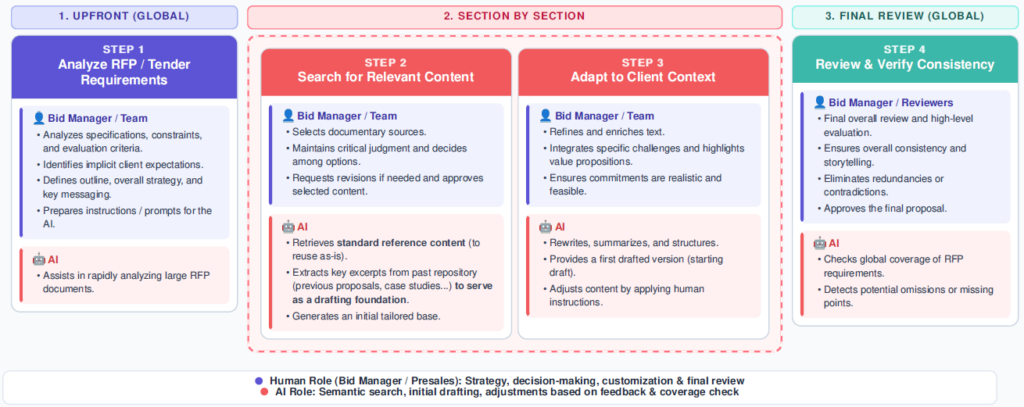
Step 1: Analyze RFP Requirements
Before searching for existing content, you must clearly understand what is expected.
The bid manager analyzes:
- RFP requirements related to the section topic,
- Specific drafting instructions or constraints,
- Evaluation and scoring criteria,
- Implicit client expectations.
AI can assist in rapidly analyzing large RFP packages, but interpreting nuances and defining the response strategy remain human responsibilities.
This step establishes the overall win strategy: Which key messages should be emphasized? Which differentiators should be highlighted? Which requirements are mandatory? These elements will be fed into prompts for the AI tool in subsequent steps to maximize answer relevance.
Tip: Perform this step once for the entire proposal before drafting individual sections. This global analysis ensures a coherent structure, identifies key messaging for each section, and maintains narrative consistency across the bid.
Step 2: Search for the Most Relevant Content in the Document Repository
Once expectations are clear, the next task is locating content suitable for reuse. Two categories of content must be distinguished:
- Standard Reference Content: Pre-approved material that should not be rewritten (e.g., corporate presentation, standard product descriptions, certifications, quality or security commitments). The goal here is to quickly retrieve the exact reference version for direct inclusion (with minor tweaks like updating the client name).
- Drafting Foundation Content: Material used to build a customized response. This includes past bid answers, technical docs, case studies, and project feedback.
In both cases, the bid manager plays an essential role: selecting sources, reviewing AI-generated suggestions critically, requesting revisions when needed, selecting among options, and approving the final content.
Good to Know: A solution like Bee4win Compose enables teams both to retrieve exact reference content and to identify relevant excerpts across the entire repository to generate a tailored initial draft.
Step 3: Adapt the Response to the Client Context
Retrieved content serves as the raw material for drafting. AI can assist in rewriting, summarizing, or structuring a preliminary draft. However, a winning proposal requires more than just well-written text.
The bid manager must ensure the content:
- Is fully aligned and compliant with client requirements,
- Integrates specific client challenges,
- Highlights relevant differentiators,
- Contains realistic and feasible commitments.
Le bid manager doit s’assurer que le contenu :
- est adapté et conforme aux attentes du client,
- intègre les enjeux spécifiques,
- met en avant les bons arguments différenciants,
- contient des engagements que l’entreprise sait tenir.
Key Point: AI provides the starting point. The bid manager refines the response to maximize win probability and project success.
Step 4: Review and Verify Overall Proposal Consistency
This final step takes place once all proposal sections have been drafted. It involves stepping back to evaluate the overall quality and cohesion of the response.
The goal is twofold:
- Ensure Complete Coverage: Verify that every RFP requirement and evaluation criterion is clearly addressed to make scoring easy for evaluators.
- Check Global Coherence: Confirm that key messages are consistently reinforced, differentiators stand out, and any redundancies or contradictions are eliminated.
An AI tool can assist by scanning for requirement coverage, flagging missing items, and verifying that answers align with tender expectations.
However, designated human reviewers retain ultimate responsibility for final sign-off—ensuring the proposal tells a compelling, coherent story and enables evaluators to easily award maximum points.
Conclusion
Effectively reusing your company’s document repository is a strategic priority for presales teams.
Generative AI solutions significantly accelerate this process by simplifying search, summarization, and coverage verification. However, their success directly depends on the quality of the underlying repository and the methodology applied.
By combining the domain expertise of bid managers and presales teams with AI tools tailored for tender management, organizations can transform internal knowledge into a genuine competitive advantage: producing faster, higher-quality, and better-customized responses that win more bids and ensure smoother project delivery.
Blog articles

Generic AI vs. Specialised AI: Which Approach for Your RFP Responses?

The Pre-Sales Strategy Toolbox: 8 Essential Tools to Win More Bids

How do you organize your response to a call for tenders ?

Copyright © 2025 Bee4win